
Let’s go through the correct method for string sizing.
1. Determine the inverter’s maximum input voltage
The most important specification is the maximum PV input voltage, which can be found on the inverter’s datasheet under the PV input voltage section.
In this example, the maximum allowable voltage is 800 V.
2. Find the panel’s open-circuit voltage (Voc)
Next, check the solar module’s datasheet — in the STC (Standard Test Conditions) table — for the Voc value.
Let’s take an example of a LONGi 440 W panel.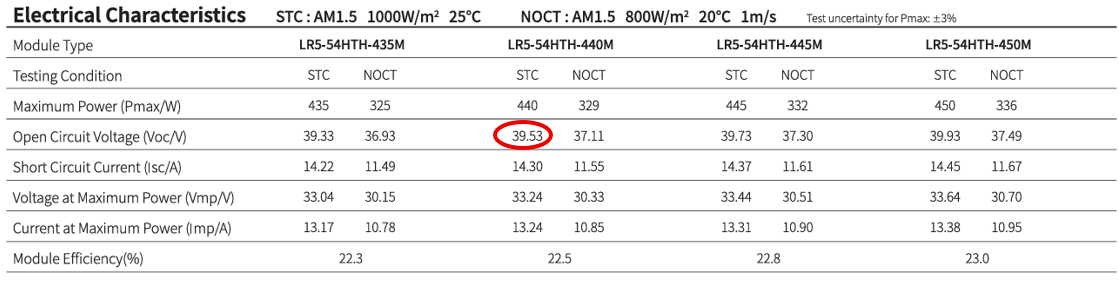
Since voltage depends on temperature, you must also consider the temperature coefficient found on the datasheet.
STC values are given at 25 °C, so if you design for –10 °C, the temperature difference is 35 °C.
3. Apply the correction formula
The formula to calculate the adjusted open-circuit voltage per panel is:

For our example:
V=39.53+0.23×35=42.71 V
4. Calculate the maximum number of panels per string
Finally, divide the inverter’s maximum input voltage by the calculated panel voltage, and round the result down to the nearest whole number — regardless of the decimal part.
800/42.71=18.73800
Thus, a maximum of 18 panels can be connected in series on one string in this case.