
When sizing the cable, we must first examine what kind of system we want to build. Key parameters include:
- Voltage level
- Current
- Cable length
- Safety factor
- Voltage drop
- Cable material characteristics
The formula for calculating the required cable cross-section is as follows:
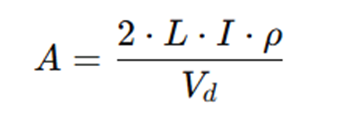
where
A: cross-sectional area
2: multiplier due to the +/- conductors, as both contribute to the total resistance
L: cable length (for one conductor)
I: current
ρ: material constant (for copper: 0.017241)
Vd: voltage drop
Using this formula, it is possible to determine the appropriate cable size for a given system configuration. For safety, it is recommended to apply a 25% safety factor. This means that in the formula, the current value I should be replaced with 1.25 times the expected maximum current.
If the resulting cross-section value is not an integer or if the calculated cable size is not available, the next larger cable size must always be used for the system.